Hall of Great Compassion 大悲殿
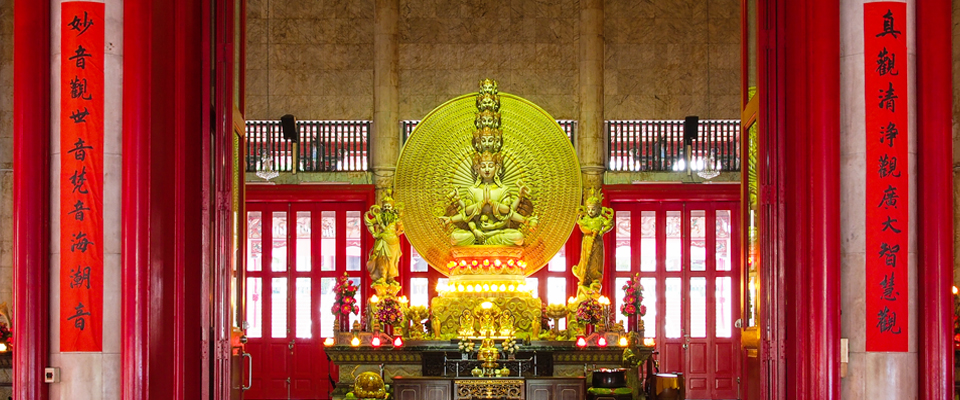
The Hall of Great Compassion, symbolising the great compassion of Avalokiteshvara Bodhisattva, was completed in 1980.
At the centre stands Avalokiteshvara Bodhisattva of a Thousand Arms and Eyes, crafted in traditional Indian style by Italian craftsmen. The thousand arms and eyes represent his immeasurable vow extend help in all directions, reaching all beings who faithfully recite his name or call upon him. Each hand bears an eye of Wisdom, guiding his compassionate action. Avalokiteshvara Bodhisattva is known for his skilful means, manifesting in diverse forms across realms to relief suffering.
Flanking Avalokiteshvara Bodhisattva are Skanda Bodhisattva and Sangharama Bodhisattva. On the far right is Manjusri Bodhisattva seated on a lion, and on the far left, Samantabhadra Bodhisattva rides a on an elephant.
In 2022, the hall underwent major upgrades. The pavilion structure was rebuilt using eco-friendly materials and an open design, enhancing both its aesthetics and sustainability. The renovation harmoniously blends tradition with modernity, and preservation with innovation.
1980年完工的大悲殿中央供奉着一尊千手千眼观世音菩萨圣像,由意大利工匠依循印度传统风格雕刻而成。这座圣像代表菩萨寻声救苦、普度十方的无量悲愿。众生若遭遇苦难,至诚诵念观世音菩萨圣号,便能感得菩萨的加持与护佑。菩萨千手各具智慧之眼,引领悲行,寓意以观照世间音声而拔苦救难;并以种种善巧方便,示现无量化身,随缘度化众生。
观世音菩萨的左侧为伽蓝菩萨,右侧为韦陀菩萨;殿堂西单供奉乘象的普贤菩萨,东单则为骑狮的文殊菩萨。
2022年,大悲殿展开翻新工程。此次工程不仅提升殿堂之美观,也重新打造亭台结构,采用环保建材与开放式设计,展现可持续建筑的理念。殿堂的翻新工程巧妙融合传统与现代精神,兼顾保存与创新,使殿堂焕发新的生命力。
DID YOU KNOW 您可知道
- The thousand arms and eyes of Avalokiteshvara Bodhisattva symbolise his immeasurable vows to reach out and save all sentient beings.
- Sangharama Bodhisattva and Skanda Bodhisattva are Dharma protectors who vowed to safeguard and protect the scriptures and diligent Dharma practitioners from harm and disturbances.
- Manjusri Bodhisattva is well-known for his great wisdom in guiding Dharma practitioners. The lion he rides represents the far-reaching power of his insight, like a lion’s roar.
- Samantabhadra Bodhisattva exemplifies the perfected diligent practice of all Buddhas and Bodhisattvas. The elephant he sits on represents steadfastness and strength.
- The pavilion comprises three canopies spanning over 40 metres and covering a floor area of 1,500 square metres. Its lightweight ETEF (Ethylene Tetrafluoro Etilene) roof membrane is a pioneering feature in Singapore. This pavilion received an “Honorable Mention in Architectural Design/Cultural Architecture” at the 2022 Architecture MasterPrize.
- 观音菩萨的千手千眼代表 “千处祈求千处应” 的大悲精神。“千”代表无量,彰显菩萨悲心之广、普度无边有情。
- 伽蓝与韦驮与菩萨是佛教的护法神将,肩负守护山门、降镇魔军之责,并曾于佛前立誓,护持正法,庇佑修行者。文殊菩萨以大智慧引导无数佛教行者。其狮子坐骑,象征说法威德如兽中之王,犹如狮子吼,百兽肃然倾听;众生闻其妙法,得以开启智慧。
- 普贤菩萨的六牙白象坐骑,象征菩萨精进行持六度——布施、持戒、忍辱、精进、禅定、般若,在度化众生之路上坚定不退,以广大行愿迈向成佛之道。
- 大悲殿的亭台由三个跨度超过40米、覆盖面积达1500平方米的罩棚组成。屋顶采用轻质四氟乙烯膜结构,为新加坡首,并于 “2022年建筑大师奖”中荣获“建筑设计/文化建筑类”荣誉提名。
Sangharama Bodhisattva 伽蓝菩萨
Standing to the left of Avalokiteshvara Bodhisattva is Sangharama Bodhisattva. In Chinese Buddhism, Guan Yu of the Three Kingdoms era is often revered as Sangharama Bodhisattva (伽蓝菩萨). According to the “Record of the Lineage of the Buddhas and Patriarchs” (《佛祖统纪》), during the Sui Dynasty, the founder of the Tiantai School, Master Zhiyi, was meditating in the mountain when Mara appeared in terrifying forms to test his concentration. Master Zhiyi remained unafraid and used Buddhist teachings to enlighten these spirits.
That night, Guan Yu appeared, repented for his past actions, and was inspired by the master’s teachings. He built a monastery to support Master Zhiyi’s propagation of the Dharma and vowed to protect the Buddhist teachings. Master Zhiyi then bestowed the Five Precepts on him, and Guan Yu became known as Sangharama Bodhisattva (伽蓝菩萨), one of the two principal Dharma protectors of Buddhist monasteries alongside Skanda Bodhisattva (韦驮菩萨).
立于观世音菩萨圣像的左侧为伽蓝菩萨。在汉传佛教中,三国时代的关羽常被尊奉为伽蓝菩萨。根据《佛祖统纪》记载,隋代天台宗祖师智者大师在山间禅坐入定时,遭遇大力鬼神以恐怖之相干扰,意图考验其定力。智者大师安然无惧,以佛法摄受教化诸鬼神。
当夜,关羽现身向智者大师陈述往昔因缘,心生惭愧。蒙大师慈悲摄受后,关羽兴建寺院以作供养,并发愿护持佛法。智者大师遂为其授持五戒,让其成为佛弟子。自此,关羽被尊称为伽蓝菩萨,与韦驮菩萨并称为佛教寺院的两大护法。
Skanda Bodhisattva 韦驮菩萨
On the left of Avalokiteshvara Bodhisattva stands Skanda Bodhisattva, clad in armour and holding a vajra, serving as the Entrance Guardian of Buddhist monasteries. As General-in-Chief of the 32 heavenly generals under the Four Great Heavenly Kings, also known as Dharma Protector, he safeguards the Dharma and assists practitioners when their cultivation is disrupted by Mara or the forces of delusion.
Born the son of a virtuous Heavenly King, he was entrusted to safeguard the Dharma as Shakyamuni Buddha entered Nirvana. From then on, he protects Sangha members whenever their cultivation is disrupted by Mara or the forces of delusion, and he also helps resolve conflicts among religious sects, maintaining peace within the Buddhist community.
立于观世音菩萨圣像的左侧为韦陀菩萨,他身着盔甲,手持金刚杵,常作为佛寺的山门护法出现。韦陀菩萨为四大天王之下三十二位天将的统帅,因此亦被尊称为护法菩萨。
韦陀菩萨原为德行高尚的天王之子,在释迦牟尼佛入涅槃之时受托守护佛法。自此,他肩负起保护僧众的职责,当僧众修行受到魔王及其随从扰乱时,必前来护持。
此外,当各宗派之间发生争执时,韦陀菩萨亦会尽职调解,化解纷争,维持佛教社区的和平与和谐。
Samantabhadra Bodhisattva 普贤菩萨
On the far left of the hall stands Samantabhadra Bodhisattva, revered as a model of great conduct and diligent practice in the Mahayana tradition. His name, “Samantabhadra”, translates to “universal virtue” in Sanskrit, reflecting his dedication to benefit all sentient beings through the practice of limitless vows.
Samantabhadra Bodhisattva is often depicted riding a six-tusked white elephant, symbolising his mastery of the Six Paramitas: generosity, morality, patience, diligence, meditation, and wisdom. The white elephant represents his pure and unwavering commitment to his vows and his practice.
According to the “Practices and Vows of Samantabhadra Bodhisattva Chapter,” he teaches that one attains the merits of a Buddha by observing ten conduct and vows practices:
- Paying homage to all Buddhas.
- Praising the Tathagatas (Buddhas)
- Making extensive offerings
- Repenting and reforming karmic obstacles
- Rejoicing in the merits and virtues of others
- Requesting the turning of the Dharma wheel
- Wishing Buddhas to remain in the world
- Always Following the teachings of the Buddhas
- Benefiting all sentient beings
- Dedicating all merits for the benefit of all beings
殿堂的左侧供奉着普贤菩萨。在汉传佛教中,普贤菩萨被喻为大乘行愿之典范。他所体现的是“行”意指“实践”,即以无量行愿的修持利益一切众生。“普贤”一词的梵文为“Samantabhadra”,又译为“遍吉”,寓意普应十方,使众生皆能受益。
普贤菩萨最易辨识的形象为六牙白象的坐骑。六牙象征六度波罗蜜,即布施、持戒、忍辱、精进、禅定及智慧;白象则代表菩萨愿行深切、精进不懈、清净无染。在《普贤行愿品》中,普贤菩萨教导善财童子,若欲成就佛功德,必须修学十种行愿:
一、礼敬诸佛
二、称赞如来
三、广修供养
四、忏悔业障
五、随喜功德
六、请转法轮
七、请佛住世
八、常随佛学
九、恒顺众生
十、普皆回向
Manjusri Bodhisattva 文殊菩萨
On the far right of the hall stands Manjusri Bodhisattva, one of the Four Great Bodhisattvas in Mahayana Buddhism and the foremost disciple of the Buddha, symbolising the pinnacle of wisdom. The name “Manjusri” means “gentle glory” in Sanskrit. He guided the seven Buddhas of the past and countless practitioners towards Buddhahood, embodying the perfect wisdom of all Buddhas and Bodhisattvas.
Manjusri is depicted riding a lion, which symbolises his authoritative and far-reaching wisdom, echoing across the ten directions. The lion also represents the power of wisdom to tame the mind, akin to subduing a ferocious beast.
殿堂的右侧供奉文殊菩萨,亦名文殊师利菩萨,是汉传佛教的四大菩萨之一,也是佛陀的上首弟子,象征智慧的典范。”文殊“为梵文“Manjusri“的音译,意为”妙吉祥“。文殊菩萨曾是过去七佛的老师,引导无数修行者证得佛果,体现诸佛菩萨的圆满智慧。文殊菩萨所骑的狮子,象征其深具权威而深广的智慧,如狮子吼般遍及十方;同时也代表以智慧驯服内心的烦恼。
You might also be interested in..
您可能感兴趣的…