Hall of Medicine Buddha 药师殿
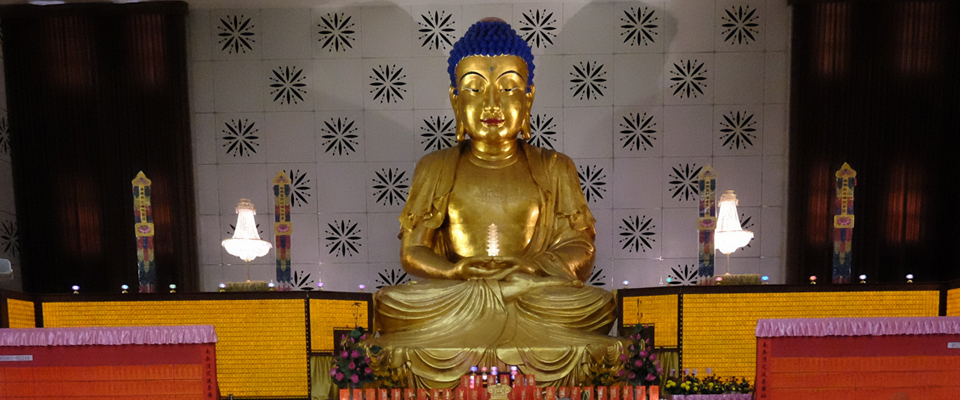
The Hall of Medicine Buddha is situated on the second level of the Pagoda of Ten Thousand Buddhas, houses one of Southeast Asia’s largest bronze images of the Medicine Buddha. Encircling the inner circumference of the stupa are ten thousand small Buddha images, symbolising the boundless and all-pervading nature of the Dharma. In the Chinese culture, the number ten thousand (万) signifies completeness and infinity, representing the countless Buddhas throughout space and time.
In Mahayana Buddhism, the Medicine Buddha is revered as the Buddha of healing. He made 12 great vows to relieve the suffering of beings who call upon him, curing both physical and mental illnesses, with delusion recognised as their root cause. He presides over the Eastern Pure Land, where Buddhas-to-be are reborn and trained, in a manner comparable to the Western Pure Land.
On the Medicine Buddha’s forehead is the Urna, a tuft of coiled hair from which he emits the light of compassion to beseech all beings to awaken to the Dharma. He is seated in the traditional meditation posture, forming the samadhi mudra, symbolising deep meditative concentration.
A swastika is depicted on his chest, a timeless symbol of auspiciousness found across many cultures. Resting in his palms is a pagoda, identifying him as the Medicine Buddha. The pagoda represents the Buddhas of the three times: the past, present and future.
万佛宝塔二楼为药师殿,供奉着东南亚最大的药师佛铜像之一。塔内沿圆周环绕万尊小佛像,象征佛法浩瀚无边、遍及虚空。药师佛,又称药师琉璃光如来,是大乘佛教中的大医王。他立下十二大愿,誓愿为一切众生治愈身心疾病,断除妄念之苦。药师佛主持东方净土,是未来佛降生与修行之地,与西方净土齐名。
药师佛通常呈禅定坐姿,手结禅定印。眉间白毫放慈悲光明,接引众生修学佛法。其胸前的卍字符号,象征吉祥与和谐,为多元文化所尊崇。药师佛手持宝塔,象征过去、现在与未来三世诸佛。
You might also be interested in..
您可能感兴趣的…